Effective learning is active, and it is social. Students need to be doing something—moving, making—and the social part is interactive talking among students, especially robust talk with higher-level thinking. |
Principles of Learning
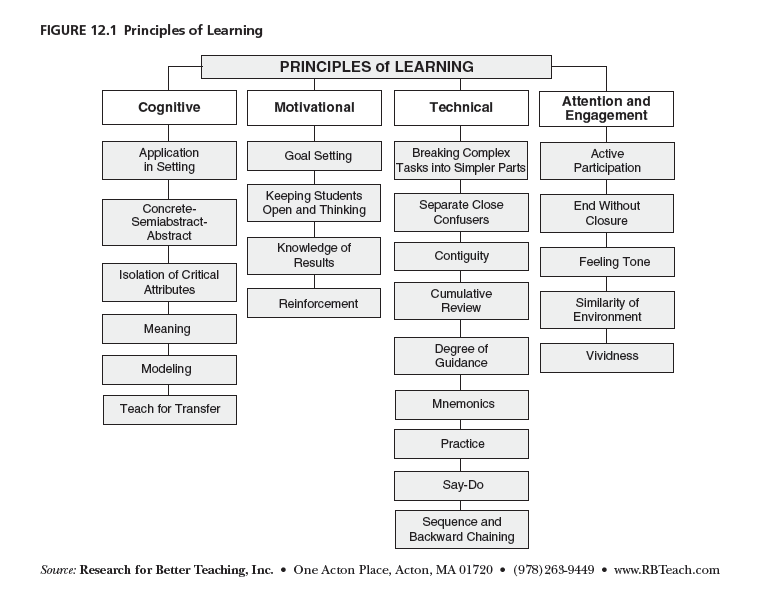
We have identified 24 of these principles in the literature (see Figure 12.1 and Table 12.1 for a more detailed explanation.). What they all share in common is that each offers some sort of guideline for designing learning experiences. One might think of principles of learning like the choice of spices in a spice rack used in food preparation: some seasonings are used regularly in most every dish a chef prepares (salt, pepper, sugar, parsley, to name a few), while others are used more selectively (cumin, tarragon, coriander). To a chef it is not a matter of the more spices the better but rather knowing the spices and applying them strategically where they will enhance the flavor. This is also the case with principles of learning: some apply broadly to most learning experiences (meaning, active participation, say-do), while others apply more selectively (isolating critical attributes, contiguity, mnemonics). Knowing the principles of learning enables us to apply them strategically to design excellent learning experiences.
The more meaningful and relevant the task or application of information is to the students' world, the easier it is to learn. |
Higher-level thinking is for all students. It needs to be planned and provoked by the questions we ask students, the tasks we give them, and the interaction with one another that the tasks set up. |
Learning can be enhanced by modeling new skills or operations and preserving these models for student reference during early stages of learning. |